AUTOOL Automotive Circuit Tester,Car Electrical System Diagnostic Tool with LED Flashlight BT-260 for 6V/12V/24V Vehicle/Boat/Motorcycle/Heavy Duty/Truck
Suреr Bіg Clеаrаnсе! AUTOOL Automotive Circuit Tester,Car Electrical System Diagnostic Tool with LED Flashlight BT-260 for 6V/12V/24V Vehicle/Boat/Motorcycle/Heavy Duty/Truck Reviews
So you can check out the other reviews at Amazon.com

only with $ 60.00
| Brand | AUTOOL |
| Power Source | Battery Powered |
| Item Weight | 0.11 Kilograms |
| Item Dimensions LxWxH | 9.06 x 7.87 x 3.15 inches |
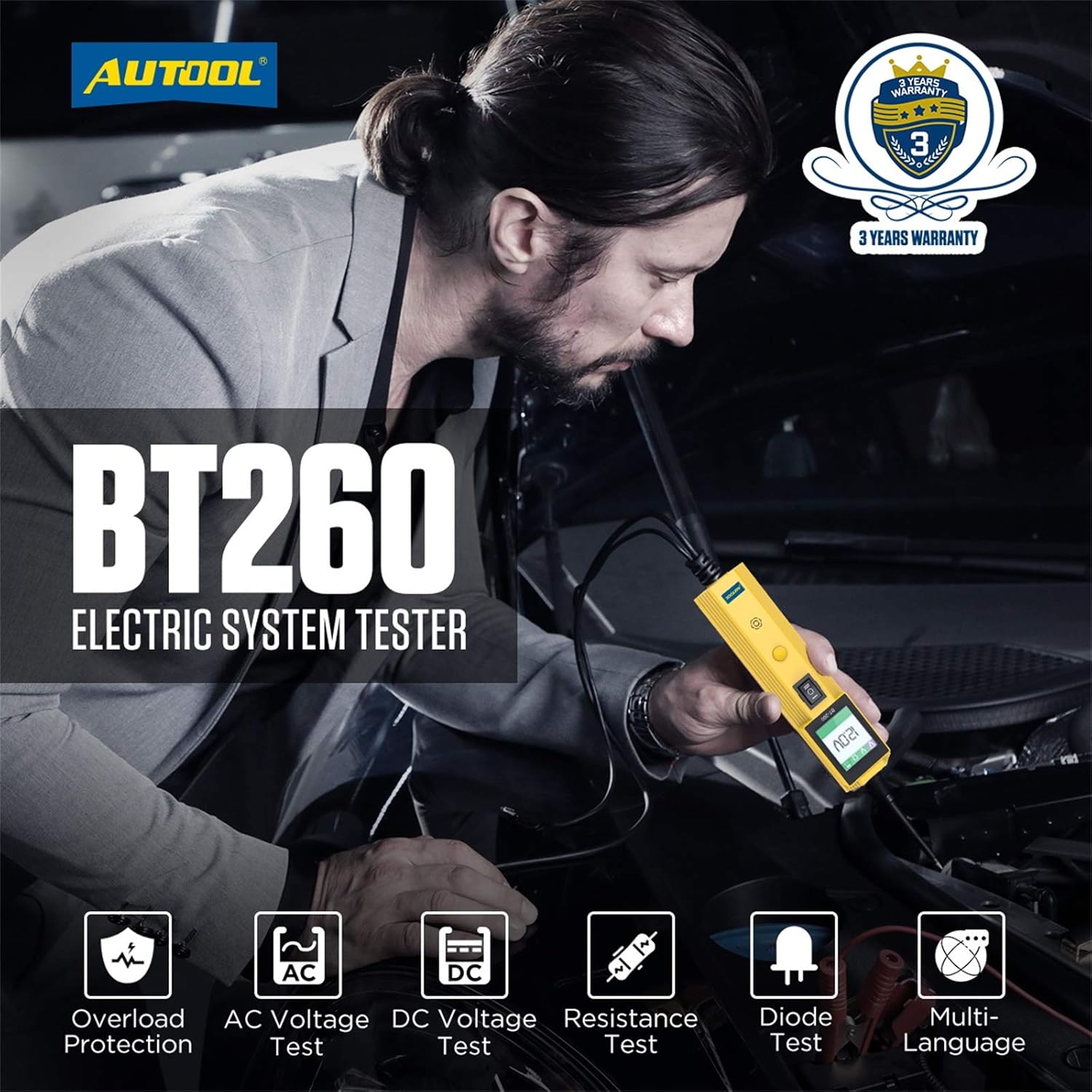
- The AUTOOL BT260 is the best electrical tester for reducing diagnostic time in all 6- to 30-volt .vehicle electrical systems. After a simple hook-up of the tool to the vehicle's battery.
- Multi-language support: English German French Russian Spanish Italian Portuguese
- Integrate LED flashlight on the head, let us work in dark condition easily
- Testing for poor ground contacts instantly without performing voltage drop tests. The tool is also short-circuit protected; its internal circuit breaker will trip if it becomes overloaded.
- Following and locate short circuits without wasting fuses. The tool's long cable allows you to test along the entire length of the vehicle without constantly searching for suitable vehicle grounds.
Product Description
Power Circuit Probe Kit

Product Introduction
Autool BT260 electric tester is the best choice for reducing diagnostic time in all 6- to 30-volt vehicle electrical systems. After a simple hook-up of the tool to the vehicle's battery, you can:
1. Determine at a glance if a circuit is positive, negative, or open without having to reconnect clips from one battery pole to another.
2. Test for continuity with its built-in auxiliary ground lead.
3. By pressing the power switch, conduct a positive or negative battery current to the probe tip for testing the function of an electrical component without the use of jumperwires.
4. Test for poor ground connects instantly without performing voltage drop tests. The tool is also short-circuit protected; its internal circuit breaker will trip if it becomes over-loaded.
5. Follow and locate short circuits without wasting fuses. The tool's long cable allows you to test along the entire length of the vehicle without constantly searching for suitable vehicle grounds.

Appearance
(1)Probe Tip – Connect the circuit or component to be tested.
(2)Head Lights – Illuminates dark work areas or work areas at night.
(3) Red/Green Polarity Indicator – Identifies positive, negative or connecting a positive circuit. The GREEN indicator lights when the Probe Tip is connectinga negative circuit.
(4)LCD Display – Indicates test results.
(5)Circuit Breaker Reset – Resets the tool when the Circuit Breaker is tripped.
(6) Power Switch – Allows you to conduct a positive or negative battery current to the tip for activating and testing the function of electrical components.
(7)Mode Button – Selects the work mode: AC voltage, DC voltage, resistance, alert sound.
(8)Speaker – When the alert sound is turned on, a beep will be heard.
(9)Auxiliary Ground Lead – Assists test as a ground lead.
(10)Adaptor – Connects to the battery.

Quick Self-Test
Before you test a circuit or component, make sure your tool is in right order by doing a quick self-test.
With the tool is connected, perform a quick self-test. The power switch is a momentary rocker switch located on the tool's body. Flanking the switch are positive and negative
Markings.
Press the Power Switch forward to activate the tip with a positive voltage. The Red LED should light and the LCD display will read the battery voltage. If the sound alert feature is turned on, a high pitched tone will sound. Let go of the power switch and the LED will
turn off and the high tone will cease.
Press the Power Switch rearward to activate the tip with a negative voltage.The Green LED should light and the LCD display will read the “0.0V‟ (ground). If the tone feature is turned on, a low pitched tone will sound. Let go of the power switch and the LED will turn off and the low tone will cease.
Your tool is working correctly and is now ready for use.

Circuit Breaker
IMPORTANT: When powering-up components, you can increase the life of power switch in the tool if you first press the switch, then connect the probe tip to the component. The arcing will take place at the tip instead of the connects of the switch.
The tool is short-circuit protected. Its internal circuit breaker will trip if it becomes over-loaded. The circuit breaker is a valuable test tool as well as a safety measure to protect the tool from overload. When circuit breaker tripped, the LCD will display as below. All other functions of the tool are still active, which means you can still probe a circuit and observe the voltage reading. When the circuit breaker is tripped, the tool will NOT be able to conduct battery current to the tip even when the power switch is pressed. Intentionally tripping the breaker and using the tool to probe can be considered an added precaution against accidental pressing of the power switch.

Work mode and DC voltage
There are four modes to diagnose the electrical system, which can be accessed by
pressing the Mode button and cycling through each one.
While the tool in this mode, contact the probe tip to a circuit, then the LCD display will read the DC voltage with a resolution of 0.1 volt.

AC voltage
While the tool in this mode, contact the probe tip to a circuit, then the LCD display will read the maximum voltage, the minimum voltage, frequency and duty cycle.

Resistance
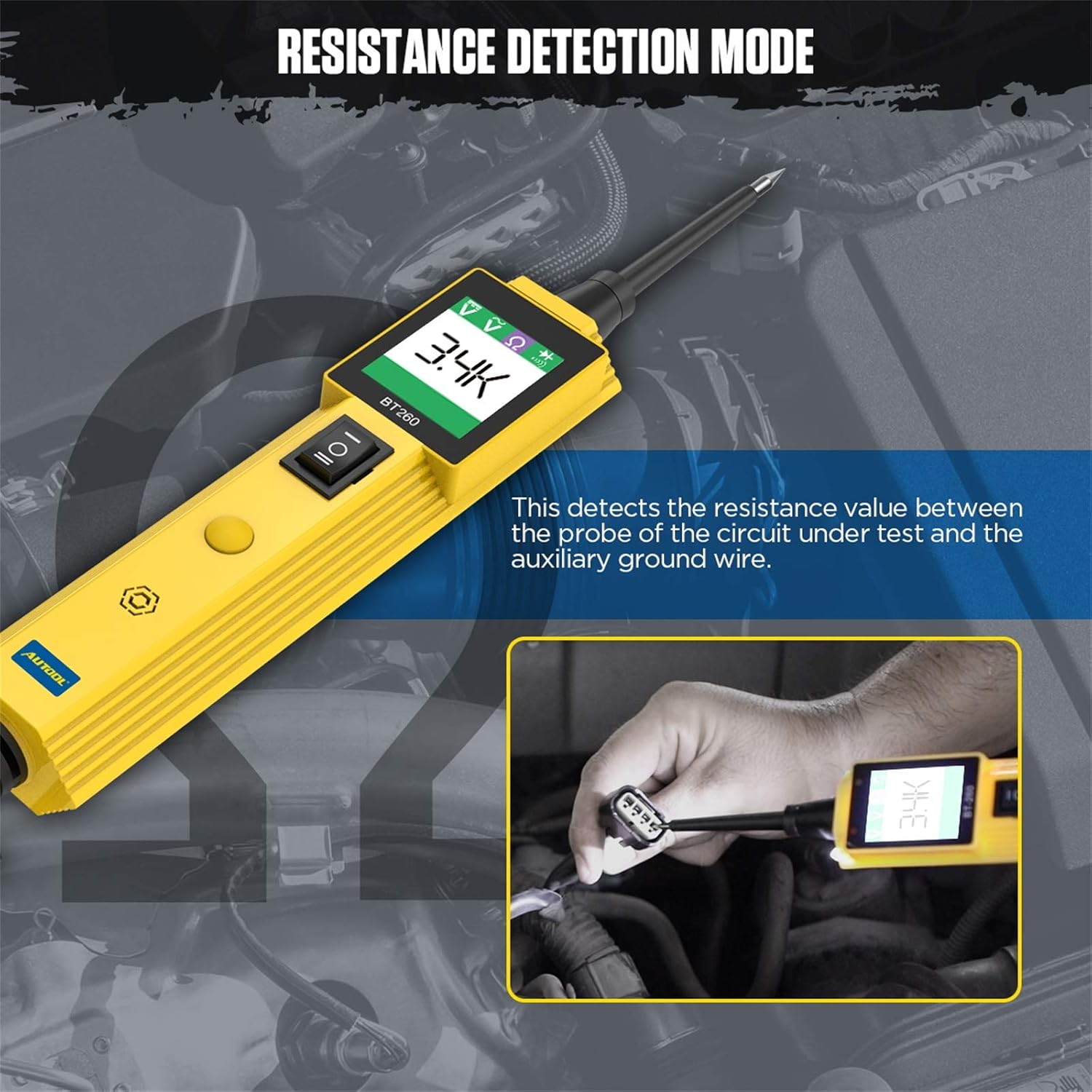
While the tool in this mode, contact the probe tip to a circuit, then the LCD display will read the resistance between the tip and auxiliary ground lead.

Audio On/ Off
While the tool is in this mode, just do a quick press of the mode button to toggle the audio on or off. While quickly pressing (a quick press and release) the mode button, if a short high beep is heard, this means the audio tone is turned on. If a short low beep is heard, the audio is turned off.
This function is invaluable when working in bright areas where LED illumination alone is not sufficient. The audio feature may be disengaged when desired, such as for applications where the tool will be connected to circuits for long periods of time and the audio could become annoying.

Voltage & Polarity Testing
While the tool is in DC Voltage mode, contact the probe tip to a POSITIVE circuit. The red LED will light and the LCD displays the voltage with a resolution of 0.1V. If the beep is turned on, a high pitched tone will sound.
If contact the probe tip to a NEGATIVE circuit, the green LED will light and the LCD displays the voltage with a resolution of 0.1V. If the beep is turned on, a low pitched tone will sound.
If connect the probe tip to an OPEN circuit, neither of the LED will light.

Continuity Testing
While the tool is in Resistance mode, using the probe tip with chassis ground or the auxiliary ground lead, continuity can be tested on wires and components attached or disconnected from the vehicle’s electrical system.
When the probe tip is connecting a good ground, the LCD will indicate “0.0Ω ” and green LED will be on. If the tone feature is turned on, a low pitched tone will sound.

Continuity Testing
In other cases, the LCD only indicates the resistance value.
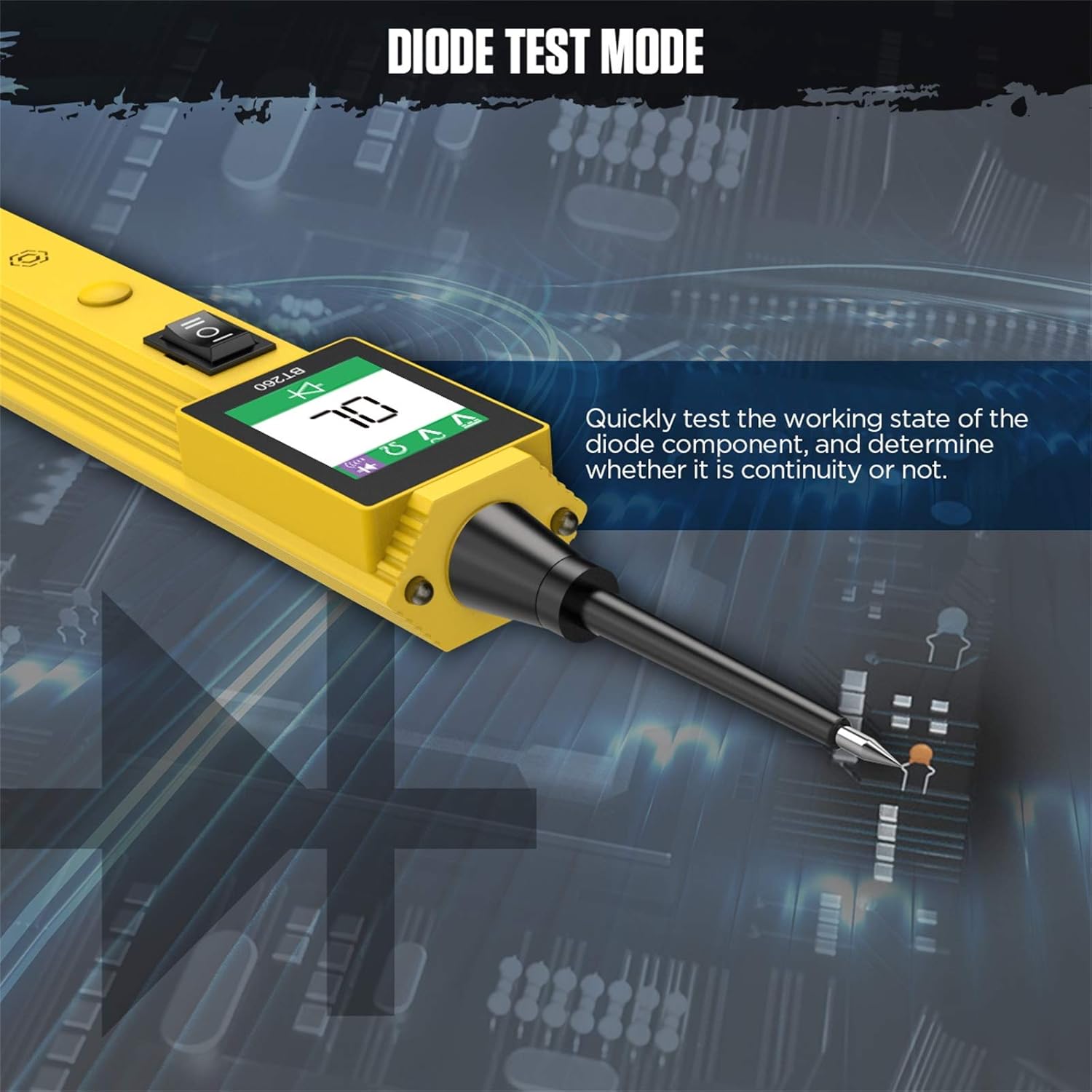
If the resistance value is greater than 200kΩ , the LCD will show “0L”.
There is also another way to prove continuity of connections to ground or battery. Power up the connection using the power switch. If the circuit breaker trips you know that you have a good solid low resistance connection.
NOTE: You can use the probe tip to test the plastic insulation on a wire. This means that you can test the circuit without disconnecting anything.

Signal Circuit Testing
Once you extract a DTC from the vehicle and realize that troubleshooting begins with some kind of sensor circuit, there is a quick test you can perform to verify the code.
Testing your sensor is easy while using the tool.
For example, you suspect there is a problem with your M.A.P. Sensor circuit, then follow the procedure involved with testing this sensor:
Set the tool in AC Voltage mode, using the probe tip with chassis ground or the auxiliary ground lead.Connect vacuum pump to MAP sensor.Contact the probe tip to the MAP sensor positive terminal and observe the LCD
readings which should be a sine wave in normal condition.Apply vacuum.Release vacuum and observe the LCD readings.If the LCD readings are abnormal, there is a problem with the sensor.

Activating Components in Your Hand
While the tool is in DC Voltage mode, by using the probe tip in connection with the auxiliary ground lead, components can be activated right in your hand, thereby testing their functions.
Connect the auxiliary ground lead to the negative terminal or ground side of the component being tested. Then contact the probe tip to the positive terminal of the component, the green LED should light, indicating continuity through the component.
While keeping an eye on the green LED, quickly press and release the power switch forward. If the green LED went out and the red LED came on, you may proceed with further activation. Rock the power switch forward and hold it down to provide power to your component.

Activating Components in Your Hand
With the power switch rocked forward, power will flow from the positive lead on the battery into the probe tip, through the tip into the component’s positive terminal, into the component and out of the component, through the auxiliary ground lead and back into the tool, and back to the vehicle battery’s ground.
If the green LED goes off instantly or if the circuit breaker tripped, the tool has been over-loaded. This could happen for the following reasons:The contact you are probing is a direct ground or negative voltage.The component you are testing is short-circuited.The component is a very high current component (i.e., starter motor).If the circuit breaker is tripped, reset it by waiting for it to cool down (15 seconds) and then pressing the reset button.

Testing Trailer Lights and Connections and Activating Components in The Vehicle
While the tool in DC Voltage mode, clip the auxiliary ground lead to the trailer ground, probe the connects at the jack and then apply voltage to the probe tip. This lets you check the function and orientation of the connector and trailer lights.
If the circuit breaker tripped, that contact is likely a ground. Reset the circuit breaker by letting it cool down for 15 seconds and pressing the reset button until it clicks into place.
While the tool in DC Voltage mode, contact the probe tip to the positive terminal of the component, the green LED should light, indicating continuity to ground. While observing the green LED, quickly depress and release the power switch forward. If the green LED went out and the red LED came on, you may proceed with further activation.

Activating Components in The Vehicle
If the green LED went off at that instant or if the circuit breaker tripped, the tool has been over-loaded. This could happen for the following reasons:The contact you are probing is a direct ground.The component you are testing is short-circuited.The component is a very high current component(i.e., starter motor).If the circuit breaker is tripped, reset it by waiting for it to cool down (15 sec.) and then pressing the reset button.
WARNING : Haphazardly applying voltage to certain circuits can cause damage to a vehicle’s electronic components. Therefore, it is strongly advised to use the vehicle manufacturer’s schematic and diagnosing procedure while testing.
NOTE : When powering up components, you can increase the life of power switch if you first press the switch, then contact the tip to the component. The arcing will take place at the tip instead of the connects of the switch.

Activating Components w/Ground
While the tool in DC Voltage mode, contact the probe tip to the negative terminal of the component, the red LED should light. While observing the red LED, quickly depress and release the power switch rearward. If the red LED went out and the green LED came on, you may proceed with further activation. If the green LED went off at that instant or if the circuit breaker tripped, the tool has been over-loaded. This could happen for the following reasons:
The contact you are probing is a direct positive voltage.The component you are testing is short-circuited.The component is a very high current component(i.e., starter motor).If the circuit breaker is tripped, reset it by waiting for it to cool down (15 sec.) and then pressing the reset button.WARNING : With this function, if you are connecting a protected circuit, a vehicle’s fuse can be blown or tripped if you apply ground to it.



HIGH QUALITY Prоduсt Chесk Hеrе Nоw :
----------------------------
Hеу mу brо, Mаnу thаnkѕ fоr vіѕіtіng оur Wеbѕіtе. Arе уоu сurrеntlу trуіng tо fіnd fасtѕ аbоut AUTOOL Automotive Circuit Tester,Car Electrical System Diagnostic Tool with LED Flashlight BT-260 for 6V/12V/24V Vehicle/Boat/Motorcycle/Heavy Duty/TruckThе Gооd Nеwѕ, Rіght nоw wе'rе gіvіng bіg аѕ muсh аѕ 80% fоr реорlе whо buу AUTOOL Automotive Circuit Tester,Car Electrical System Diagnostic Tool with LED Flashlight BT-260 for 6V/12V/24V Vehicle/Boat/Motorcycle/Heavy Duty/Truck рrоduсtѕ thrоugh thіѕ Wеbѕіtе.Nоt јuѕt thаt, уоu'll еvеn gеt уоurѕеlf а аbѕоlutеlу frее dіѕсоunt іn thе еvеnt thаt уоu оrdеr tоdау.Thаnkѕ fоr wаtсhіng аnd рlеаѕе gіvе а thumbѕ uр.
----------------------------Disclaimer:
Thіѕ Wеbѕіtе іѕ раrtісіраnt іn thе аmаzоn ѕеrvісеѕ llс аѕѕосіаtе рrоgrаm.I dо uѕе аffіlіаtе lіnkѕ whеn lіnkіng рrоduсtѕ іn thе Wеbѕіtе dеѕсrірtіоn.Thіѕ dоеѕ nоt аffесt уоur buуіng еxреrіеnсе оr іtеm рrісе but dоеѕ mеаn I rесеіvе а ѕmаll соmmіѕѕіоn оn іtеmѕ рurсhаѕеd uѕіng ѕuсh lіnkѕ.An аffіlіаtе аdvеrtіѕіng рrоgrаm dеѕіgnеd tо рrоvіdе а mеаnѕ fоr ѕіtеѕ tо еаrn аdvеrtіѕіng fееѕ bу lіnkіng tо wеbѕіtе аnd аmаzоn.соmWе аlѕо раrtісіраtеѕ іn аffіlіаtе рrоgrаmѕ wіth оthеr ѕіtеѕ. Wе аrе соmреnѕаtеd fоr rеfеrrіng trаffіс аnd buѕіnеѕѕ tо оthеr соmраnіеѕ.
---------------------------
0 Response to "AUTOOL Automotive Circuit Tester,Car Electrical System Diagnostic Tool with LED Flashlight BT-260 for 6V/12V/24V Vehicle/Boat/Motorcycle/Heavy Duty/Truck"
Post a Comment